Conventional instruments
The surgeon uses mechanical alignment guides and cutting blocks. It is a well-established procedure with long clinical experience behind it.

If you are considering traveling to Mexico for a knee replacement, you deserve clear information before you book anything: how long to stay, what the surgery involves, what it costs and how to plan a careful trip home. This guide is written by Dr. Mario Luis Balcázar Ganem, an orthopedic surgeon whose practice is dedicated to the knee and shoulder.
Every recovery is different. This outline helps you plan lodging and time off; the exact dates are adjusted to how you progress.
| Stage | What happens |
|---|---|
| Before traveling | Gather your standing knee X-rays, prior reports and medication list, complete the Oxford Knee Score and arrange dates with the clinic. Keep your return flight flexible. |
| Days 1–2 | In-person consultation and exam, imaging review and pre-op labs, imaging or medical assessment as needed. If surgery is indicated, you receive a written estimate in MXN. |
| Days 3–5 | Surgery and hospital stay. You start walking with support under supervision; the day of discharge depends on your recovery and is decided by the surgical team. |
| Days 6–14+ | Local early physical therapy, DVT prevention follow-up and wound review before medical clearance for flying home. |
In both techniques, the worn surfaces of the knee are replaced with a metal and polyethylene implant. The difference is in how the bone cuts and implant position are planned and carried out.
The surgeon uses mechanical alignment guides and cutting blocks. It is a well-established procedure with long clinical experience behind it.
An optical tracking camera maps the surface of your knee during surgery, so no preoperative CT scan is needed. The surgeon builds a plan on screen and a handheld robotic tool helps execute it.
Studies report more consistent implant positioning on X-rays with robotic assistance, while patient-reported function at short- to mid-term follow-up has been broadly comparable to the standard technique.
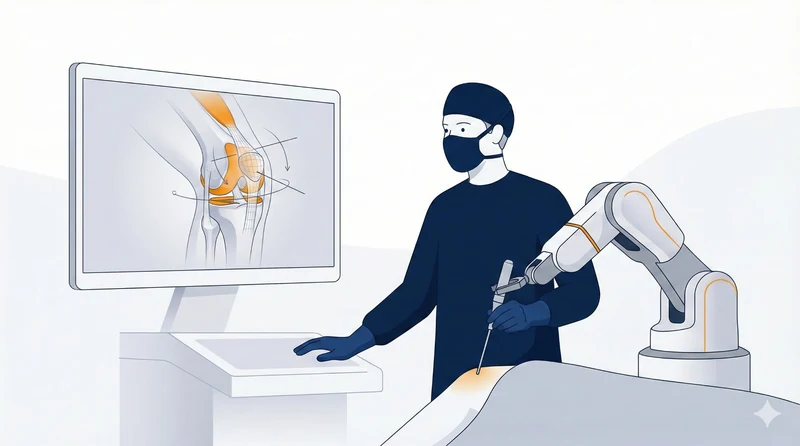
Which option suits you depends on your anatomy, the pattern of wear and your goals; we decide it together after the exam. Read more in the robotic knee replacement guide or the AAOS overview of robotic-assisted joint replacement.
These ranges apply exclusively to self-pay patients (paying privately, without an insurer). Your exact quote is given in writing after the in-person exam and depends on hospital, supplies and complexity.
| Service | Self-pay range (MXN) |
|---|---|
| In-person consultation (30 min) | $800 MXN |
| Standard total knee replacement | $141,500–$169,340 MXN |
| CORI robotic-assisted knee replacement | $172,000–$204,720 MXN |
| Revision knee replacement | from $195,000 MXN |
Lodging, flights and local transport are not included and are arranged by you.
The published ranges do not reflect hospital amounts billed through insurance. With a Mexican or international insurer, hospital charges and agreements vary widely — roughly +100% to +300% over the self-pay packages as an illustrative range, depending on hospital tier, severity, insurer agreements and supplies.
For reimbursement when your policy covers it, the clinic provides an itemized CFDI invoice (the official Mexican electronic invoice) and a medical report in English or Spanish. Ask your insurer in advance which documents they require.
Orthopedics and Traumatology — Joint Surgery and Sports Medicine. Practice dedicated exclusively to the knee and shoulder, in clinical practice since March 2013. Consultations are held directly in English.
If you will fly home on a long flight, many patients plan a local stay of roughly 2 to 3 weeks. The date you can travel is decided case by case by Dr. Balcázar after reviewing your recovery, your wound and your clot-prevention (DVT) plan, so keep your return ticket flexible.
Both replace the worn joint surfaces with an implant. With CORI, the surgeon maps your knee during surgery with an optical tracking camera, without a preoperative CT scan, and uses a handheld robotic tool to help execute the plan. Studies report more consistent implant positioning on X-rays, while function at short- to mid-term follow-up has been broadly comparable.
2026 reference ranges for self-pay patients are $141,500–$169,340 MXN for a standard total knee replacement, $172,000–$204,720 MXN for CORI robotic-assisted knee replacement and from $195,000 MXN for revision knee replacement. The in-person consultation costs $800 MXN, and a written estimate is provided after it.
It depends on your policy. The published ranges apply only to self-pay patients; with Mexican or international insurance, hospital charges are usually considerably higher, roughly +100% to +300% as a guidance range. The clinic provides an itemized CFDI invoice and a medical report in English or Spanish for reimbursement when your policy allows it.
No. Bring the standing knee X-rays and reports you already have, on disc or as a digital link. If an essential study or pre-op test is missing, the clinic helps you coordinate it in Querétaro during your first days, when possible on the same day as your consultation.
Knee and shoulder care in English at Centro Médico Jurica, Querétaro.