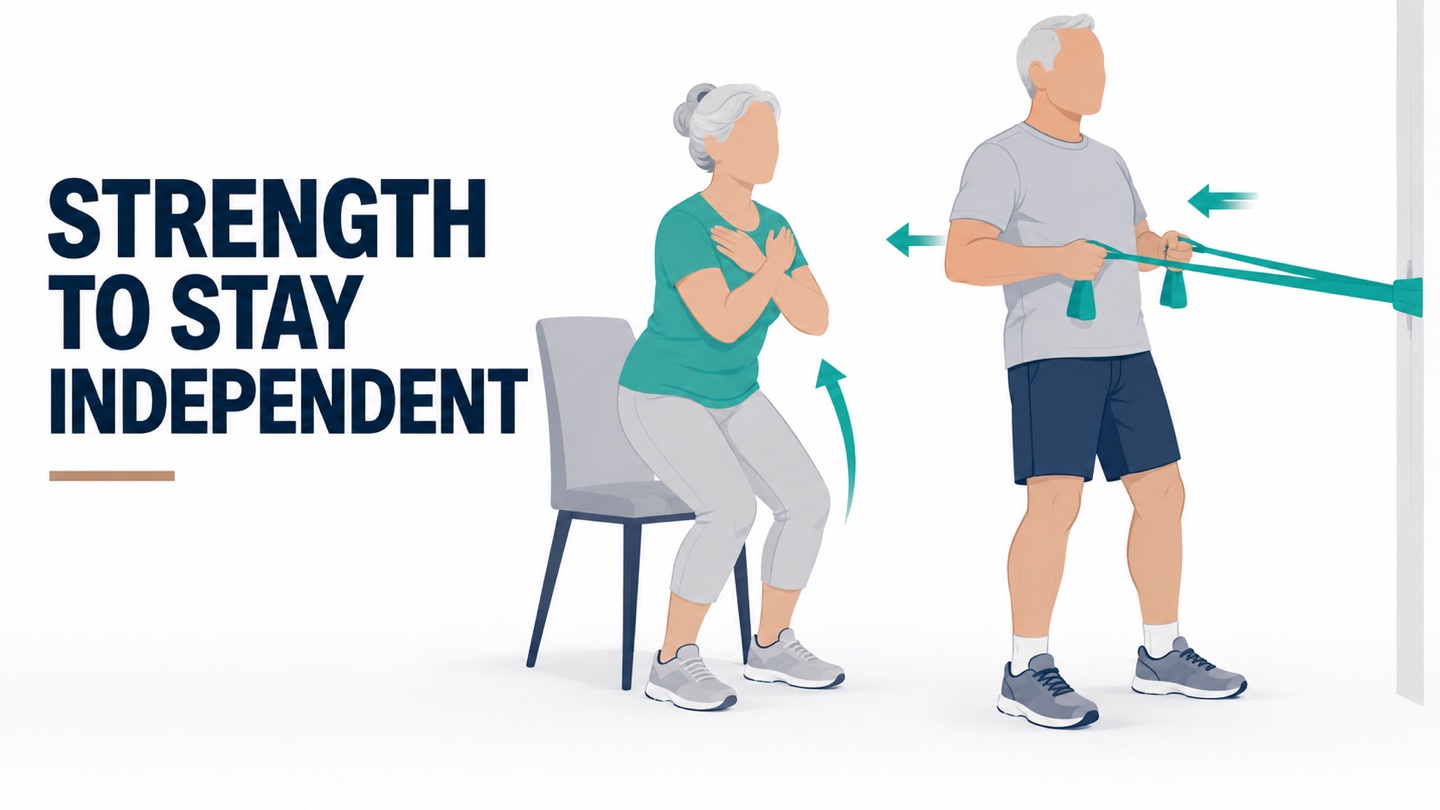
With age, standing from a chair, climbing stairs, carrying groceries or regaining mobility after an illness may become harder. This is often dismissed as “just aging,” yet muscle strength and physical function are important and modifiable parts of the picture.
The goal is not bodybuilding. It is keeping enough capacity for daily life and maintaining confidence in movement. Muscle can still respond to training at older ages when exercise, nutrition and recovery are adapted to the individual.
Muscle mass, strength and function are different
Muscle mass describes how much muscle a person has. Strength is the force that muscle can produce. Physical function is how those qualities support tasks such as walking, balancing and standing.
The EWGSOP2 European consensus defines sarcopenia as a muscle disease and gives low strength a central role. Low muscle quantity or quality confirms the diagnosis, while low physical performance indicates greater severity. A scale or scan alone does not tell the whole story.
Function matters
Two people with similar muscle mass may have different strength and mobility. Assessment may include chair stands, gait speed, balance, grip strength and, when appropriate, a measure of muscle mass.
Why strength matters for independence
Muscles work whenever you stand, change direction, recover from a stumble or control a joint. Maintaining strength can support:
- Daily mobility: walking, climbing steps and standing with less relative effort.
- Balance reactions: responding to a loss of stability.
- Joint control: sharing loads around the knees, hips, ankles and shoulders.
- Functional reserve: participating in rehabilitation after illness, inactivity or surgery.
- Confidence: helping interrupt the cycle of fear, inactivity and further weakness.
Strength does not prevent every fall or guarantee recovery. Vision, medication effects, balance, footwear, the home environment and other health conditions also matter.
What is sarcopenia?
Sarcopenia is not simply being thin. It can occur at a normal body weight or alongside excess body fat. Aging, inactivity, inadequate food intake, chronic illness and bed rest may all contribute, often in combination.
Seek assessment when standing, walking or climbing stairs becomes progressively harder, after falls, with rapid weakness or with unintentional weight loss. A sudden change should not automatically be attributed to age.
The main tool: adapted resistance exercise
The World Health Organization recommends muscle-strengthening activities involving major muscle groups on at least two days each week for older adults. It also recommends varied multicomponent activity emphasizing functional balance and strength on three or more days each week to support function and help prevent falls.
These are population targets, not instructions to do everything immediately. Someone who is sedentary, frail, in pain or recovering from illness may need a shorter, assisted or supervised start.
Practice sitting and standing from a stable chair, using support if needed.
Use bands, body weight, machines or loads that permit controlled technique.
Exercise near secure support and progress according to assessment.
Allow rest, sleep and adjustment when symptoms do not settle.
What should the effort feel like?
Exercise should feel challenging without losing posture, control or breathing. Stop a set before technique breaks down. When a movement feels comfortable over several sessions, progress one factor at a time—resistance, repetitions, range or complexity.
Walking, swimming and cycling provide cardiovascular benefits, but they do not fully replace resistance training. A useful plan combines aerobic activity, strength and balance according to the person's needs and preferences.
Protein and nutrition: food first
Muscle needs enough energy and amino acids to maintain itself and respond to exercise. The ESPEN guideline for older adults recommends at least 1 gram of protein per kilogram of body weight per day as a general reference, with intake adjusted for activity, nutritional status, illness and tolerance.
This is not a universal prescription. Kidney or liver disease, malnutrition, swallowing problems, unintentional weight loss and acute illness call for individual advice from the medical or nutrition team.
| Practical idea | Example |
|---|---|
| Spread protein through the day | Include a source at main meals rather than concentrating it in one meal. |
| Start with foods | Eggs, fish, poultry, dairy, beans, lentils, soy and options that fit your health and preferences. |
| Eat enough overall | Very low energy intake also makes preserving muscle harder. |
| Address barriers | Dental problems, low appetite, constipation or difficulty shopping and cooking. |
Protein supplements are not mandatory and do not replace a complete diet. They may be considered when food cannot meet needs or when clinically indicated, after reviewing kidney health, interactions and product quality. No powder replaces a training stimulus.
When professional assessment is especially useful
Assessment is particularly helpful after falls, with fear of falling, new use of a cane or walker, rapidly developing weakness, unintentional weight loss, persistent pain or a clear reduction in activity.
Before starting or increasing exercise, seek advice after recent surgery or fracture or with unstable heart or lung disease, fainting, chest pain, disproportionate breathlessness, neurological disease, complicated diabetes or kidney disease that affects nutrition. Stop exercise and seek care for chest pain, fainting, severe breathlessness or a sudden concerning symptom.
Pain should be interpreted, not ignored
Mild, short-lived muscle soreness may occur when starting. Sharp pain, marked swelling, instability or symptoms that worsen and fail to recover mean the plan should be adjusted and the cause assessed.
A realistic way to begin
- Choose useful movements: standing, pushing, pulling, heel raises and controlled carrying.
- Use stable support: a sturdy chair, rail or supervision when fall risk is present.
- Start with a tolerable dose: consistency matters more than an exhausting session.
- Track function: notice changes in standing, walking and everyday tasks—not only body weight.
- Progress one variable at a time: resistance, repetitions, range or difficulty.
Frequently asked questions
Is it too late to gain strength after age 70?
No. Trials reviewed in the literature show that resistance training can improve strength and function in older adults. Response varies, and the plan should match the starting point.
Is walking enough?
Walking is valuable but does not fully replace strength training. It can be combined with appropriate resistance and balance exercise.
Do I need a protein supplement?
Not necessarily. Food intake, appetite and distribution should be reviewed first. A supplement may be considered when food is insufficient or there is a clinical indication.
How can I tell whether I am losing strength?
Standing from a chair, climbing stairs, walking or carrying familiar objects may become harder. Assessment can examine strength, gait, balance and, when appropriate, muscle mass.
Is sarcopenia diagnosed with a scale?
No. Diagnosis combines strength, muscle quantity or quality and physical performance. The exact assessment depends on the clinical setting and available tools.
Are weakness or joint pain limiting your mobility?
An orthopedic assessment can identify joint barriers and help coordinate a safe plan with rehabilitation and nutrition when appropriate.
Sources
- Cruz-Jentoft AJ, et al. Sarcopenia: revised European consensus on definition and diagnosis. Age and Ageing. 2019;48(1):16–31. doi:10.1093/ageing/afy169.
- World Health Organization. WHO guidelines on physical activity and sedentary behaviour. 2020. Official publication.
- Volkert D, et al. ESPEN practical guideline: Clinical nutrition and hydration in geriatrics. Clinical Nutrition. 2022;41(4):958–989. doi:10.1016/j.clnu.2022.01.024.
- Mañas A, et al. Unsupervised home-based resistance training for community-dwelling older adults: a systematic review and meta-analysis of randomized controlled trials. Ageing Research Reviews. 2021;69:101368. doi:10.1016/j.arr.2021.101368.
Evidence reviewed: September 10, 2026. This educational article does not replace individualized medical, rehabilitation or nutrition advice.

Dr. Mario Luis Balcázar Ganem
Orthopedic Surgeon | Joint Surgery Specialist
Centro Médico Jurica, Querétaro
View profile →